Knowledge Sharing Conference
ERIA and Wood Mackenzie Discuss Policy Readiness and Government Support on CCUS Deployment in Asia Pacific
The 14th Knowledge Sharing Virtual Conference, 24 April 2024: As a major emitter of global industrial emissions today, the Asia Pacific (APAC) region must explore a viable pathway towards achieving net zero. With population and economic growth expected to continue, the region anticipates a corresponding increase in energy demand to satisfy its growing needs. Low-carbon technologies, such as Carbon, Capture, and Storage (CCS), as well as Carbon, Capture, Utilisation, and Storage (CCUS), serve as possible solutions for APAC to achieve carbon neutrality. CCUS could mitigate over 15 percent of total emissions needed to meet the goals outlined under the 1.5℃ scenario. Globally, there has been remarkable growth in CCUS projects, nearly a 25x increase, since 2019 and interest in the technology is also on the rise. North America and Europe lead the deployment of CCUS projects, however, with a global capacity of 1.2 billion tonnes per annum (Btpa) in the pipeline, there is even greater interest in CCUS development.
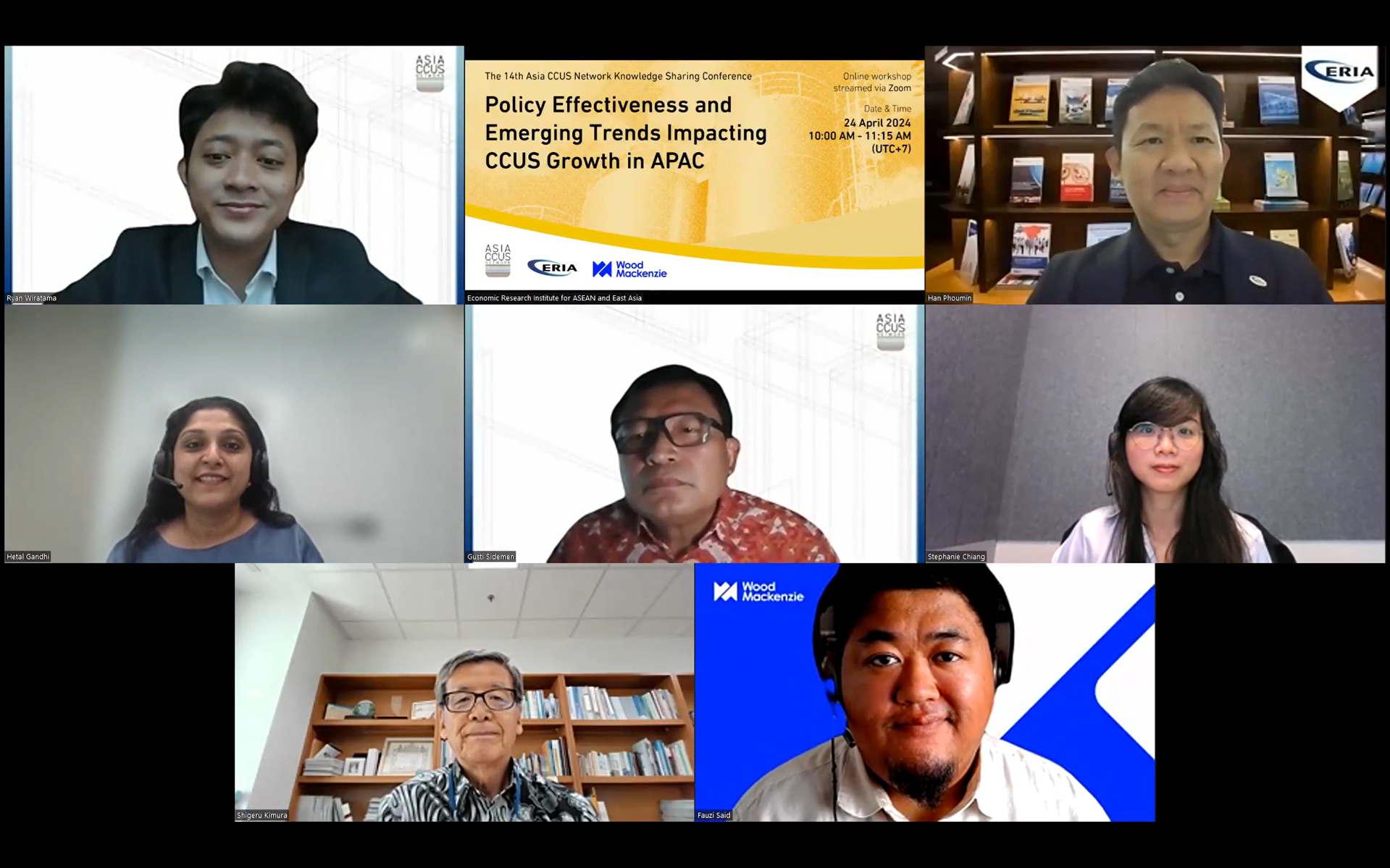
To deepen the discussion on the opportunities of this technology for the region and the readiness of APAC countries to advance and deploy CCUS, the Economic Research Institute for ASEAN and East Asia (ERIA), as the secretariat for the Asia CCUS Network (ACN) hosted the 14th ACN Knowledge Sharing Conference. The latest edition of the conference centred on the theme of ‘Policy Effectiveness and Emerging Trends Impacting CCUS Growth in APAC.’ This event was held in collaboration with Wood Mackenzie, a distinguished company recognised for its expertise in data and analytics on energy transition, renewables, and natural resources.
Mr Shigeru Kimura, Special Advisor to the President on Energy Affairs, ERIA delivered the Opening Remarks, emphasising the critical role of government policy support and effective financing mechanisms to spur CCS/CCUS advancements in Asia. He further highlighted the need for an international cooperation framework to facilitate technology transfer and investment flow from developed countries to developing countries. Mr Kimura explained that ACN’s vision is to contribute to carbon neutrality through the development and deployment of CCS/CCUS in Asia. Based on ACN’s roadmap, CCUS pilot projects are expected to commence in 2025 followed by the shift to the commercial stage by 2030. As such, ACN Member Countries must address legal and regulatory framework including license, safety, and environmental issues on CCUS activities.
Ms Hetal Gandhi, CCUS Lead for the Asia-Pacific, Wood Mackenzie led the Presentation Session about 'Delivering CCUS Potential in APAC: Policy Efficacy and Ecosystem Dynamics,’ focusing on four aspects: emissions, investments, expectations, and policies. Dr Gusti Sidemen, CCUS Research Fellow, ERIA served as the moderator. The relevance of APAC in the discussion of CCUS technology is due to the region’s 53 percent contribution to global gross emissions, followed by North America at 16 percent and EU27 at eight percent. Even more concerning, the hard-to-abate emissions from power and industry account for nearly 82 percent of APAC’s total emissions compared to 75 percent globally. Furthermore, APAC is responsible for over 60 percent of industry and energy-linked global emissions. These realities establish the significance of APAC in the broader decarbonisation discourse and highlight the need for advancing CCUS in the region.
To show the relevance and importance of CCUS, Ms Gandhi presented a base case scenario and a net zero scenario, with a focus on the former during the knowledge sharing conference. She explained that ‘various technologies have various roles to play to reduce emissions incrementally,’ particularly, to reach the net zero scenario. Based on Wood Mackenzie’s analysis, the movement from the base case scenario to the net zero scenario entails a 40 percent decrease in incremental emissions through carbon capture (CC) and removal technologies encompassing CCS and direct air capture. Ms Gandhi stated, ‘CCUS itself contributes 15 to 20 percent of the incremental drop in emissions.’ To achieve the base case scenario, CC and removal technologies will require approximately 850 million tonnes per annum (Mtpa) of capacities while CC and utilisation stand at around 546 Mtpa. ‘All in all, we believe that by 2034, CCUS capacity could reach up to 440 Mtpa,’ Ms Gandhi shared.
As of 2023, the operational capacity of CCUS in the world is around 56 Mtpa, with the largest capacity in North America at 65 percent, Europe at five percent, and APAC at nearly 22 percent. Currently, APAC has an operational capacity of 12 Mtpa in which China and Australia account for 10 percent of that capacity. Based on Wood Mackenzie’s analysis, out of 950 projects that the company tracks, overall global operational capacity is expected to increase to 440 Mtpa by 2034, of which 309 Mtpa is risked capacity. Ms Gandhi explained, ‘A large percentage of these risked capacities are spread across North America and Europe at around 75 percent. Clearly, the incentive-based policies which are announced in the US, Canada, the UK, EU27, and a number of other European countries are driving announcements of capacities in these regions.’
Moreover, Wood Mackenzie believes that there is around 125-135 Mtpa in additional capacity which will also be driven by North America. Over the past year, North America has announced nearly 45 to 50 Mtpa of additional capacity which Ms Gandhi attributed to the provision of incentive schemes; Europe is expected to follow suit in the coming years. In APAC, ‘the split between formed up capacities and capacities which are not yet announced but would come up is almost 50/50 by the time we reach 2034’ and as such, policies are integral to boost the capacity. China is predicted to add a minimum of 25 Mtpa of capacities while Australia, Indonesia, and Malaysia would account for around 50 Mtpa of additional capacities.
According to Ms Gandhi, projections indicate that by 2034, nearly half of the projects in APAC will be categorised as risked capacity, with 16 percent classified as under advanced development. Globally, the announced risked capacities represent a total value of $200 billion in real terms, with $140 billion stemming from the risked investment of the unrisked capacities. Additionally, there is an anticipated $50 billion worth of investments on the horison, suggesting that CCUS investment opportunities worldwide could potentially reach $190 billion. In APAC alone, the opportunity is estimated to range between $16 billion and $20 billion by 2034. Investment in carbon capture will make up the bulk of the share followed by carbon storage and transportation.
To support CCUS deployment, policy and regulatory support are essential. While North America and Northwest Europe lead CCUS policy readiness, progress is underway in APAC. Ms Gandhi stated, ‘When you look at CCUS, you see that investments are focused on North America and Europe and in APAC with Australia and some of the Southeast Asian economies. We’re seeing deployments picking up substantially.’ The year 2024 has seen a flurry of CCUS announcements, with Indonesia taking the lead in the Asian region with its policy adjustments. Additionally, Japan and South Korea have made announcements regarding CCUS transportation while Wood Mackenzie anticipates further CCUS policy and regulation announcements from India and Malaysia later in the year.
Based on valuations for 60 projects conducted by Wood Mackenzie, the company observed that the average internal rate of return (IRR) ranged from 14 percent to 15 percent, although there are 12 projects with an IRR below 10 percent. Ms Gandhi noted that projects with an IRR below 10 percent received incentives and are typically either stand-alone projects or hub users. Stand-alone projects and smaller hub users become financially viable when they achieve an IRR above 15 percent. This highlights the challenges faced by capturing technology projects in terms of viability, emphasising the importance of government funding to enhance sustainability. Notably, North America and Europe have direct and indirect incentives while there is nearly $80 billion worth of direct incentives for CCUS projects in the pipeline from various governments. Forms of incentives include capital expenditure grants, operational expenses of subsidies, and tax reimbursements, among others, deployed by governments to support CCUS initiatives.
To accelerate CCUS deployment, policies including hub-based policies are critical to clarify and establish in APAC. Ms Gandhi stipulated that policy actions by large emitters such as China and India will be closely monitored going forward, and hub-based policies especially from Malaysia, Indonesia, and Australia are expected to take centre stage. APAC must act swiftly, with careful attention to policies concerning incentives, carbon market development, and technical considerations such as liability risks, shipping regulations, and hub establishment. Policies related to carbon markets, trading, and frameworks will be essential, as they will lay the groundwork for understanding product premiums in hard-to-abate sectors. Further, although developing countries may not offer incentives on the same scale as developed nations, viability gap funding remains essential for supporting the implementation of CCUS projects. ‘There are best practices which are present in Europe which can be adapted by the APAC hubs while they are setting up those policies,’ Ms Gandhi stated.
During the Open Discussion session, a question was raised about the result of Wood Mackenzie’s finding for CCUS capacity projections. Ms Gandhi explained that through their methodology, the company was able to identify that the buildout for CCUS capacity in APAC has only recently begun and as such, the curve is extremely steep. ‘Once we reach a particular level of capacity then there will be more projects which will be waiting for an incentives policy and only then will announcements take place. That is the time when you will start seeing a U-curve happening to that capacity number,’ she explained. Another question was raised about incentives for CCUS projects as part of petroleum development, with a focus on Malaysia. Ms Gandhi shared that the types of incentives and policies for such projects will depend on the business model that emerges for that particular sector. For example, within Europe’s industrial carbon policy, considerations are being raised about exit policies for ‘specific sectors where [the] evolution of CCUS application has gone up substantially.’
Regarding policies to position APAC as a potential hub, Ms Gandhi outlined three key stages for hub development. First and foremost, there must be clear and well-defined policies covering emissions from both domestic emitters and the import of carbon storage, while ensuring transparency throughout. Moreover, a comprehensive framework on the operational side encompassing insurance and liability risks is equally integral as business strategies are influenced by such factors. To expedite the process of establishing itself as an international hub, a government must take proactive steps, including engaging in bilateral agreements and implementing necessary policies. The third stage involves determining whether any incentive mechanisms will be offered to further incentivise hub development.
Mr Sidemen raised the issue of APAC’s readiness to use the carbon market and a realistic carbon price for the region. Ms Stephanie Chiang, Research Analyst, CCUS, and Wood Mackenzie gave an overview, explaining that in the CCUS value chain, the cost of capture can make up nearly 70 percent of the total levelised cost of CCUS. She pointed out that energy prices play a crucial role in lowering capture costs, giving countries like Indonesia and Malaysia an advantage over Japan in this aspect. Additionally, large storage capacities can reduce capture costs further, thus Indonesia, Malaysia, and Australia can serve as hubs for countries that lack domestic storage capacity. Therefore, innovations capable of reducing capture costs would inevitably impact the price of carbon.
Ms Chiang highlighted the cost difference between pre-combustion and post-combustion, noting that pre-combustion costs can be as low as $20 per tonne of CO2, whereas post-combustion costs can exceed $100. After factoring in the transportation component, the carbon price, using pipelines of mixed onshore and offshore, ranges between $20 and $30 per tonne of CO2. Conversely, shipping could set the carbon price at an average of $50 per tonne of CO2. Ms Chiang cautioned against enforcing common pricing in the short term as it could significantly increase carbon prices, potentially triggering inflation and adversely affecting export competitiveness. She suggested adopting an approach akin to more advanced markets, such as the US and Europe which integrate carbon pricing with government support and incentives.
When discussing types of government support for hard-to-abate sectors, Ms Gandhi highlighted two key forms: support for research and development, and incentives for technologies that can be effectively implemented at scale. She cited the US as an example where such support has been successfully conducted. Under the Inflation Reduction Act, the US government allocated $1.5 billion to $2 billion to cement plants shortlisted for CCUS implementation. Ms Gandhi emphasised that incentives provided during the early stages of technology development could significantly accelerate the process of scaling up these technologies. Consequently, this would lead to lower CCUS costs in the long run.
In his Closing Remarks, Dr Han Phoumin, Senior Energy Economist, ERIA expressed his optimism on the future of CCUS deployment globally and in APAC. He mentioned that, according to the International Energy Agency, investment in CCUS has nearly doubled since 2017, which had reached $11 billion at the time, and is projected to potentially reach $190 billion by 2034. Effective policy support and ensuring project bankability will be critical to making sure that the expected CCUS investment is realised. Dr Phoumin also noted that according to an ACN study, Southeast Asia has 200 gigatonnes of storage capacity which ideally positions it as a potential regional hub, with Indonesia at the forefront. Dr Phoumin ended his speech highlighting the significance of international cooperation to reduce costs and exploring existing mechanisms, such as Japan’s Joint Crediting Mechanism, as a means of bridging the CCUS funding gap for developing countries.